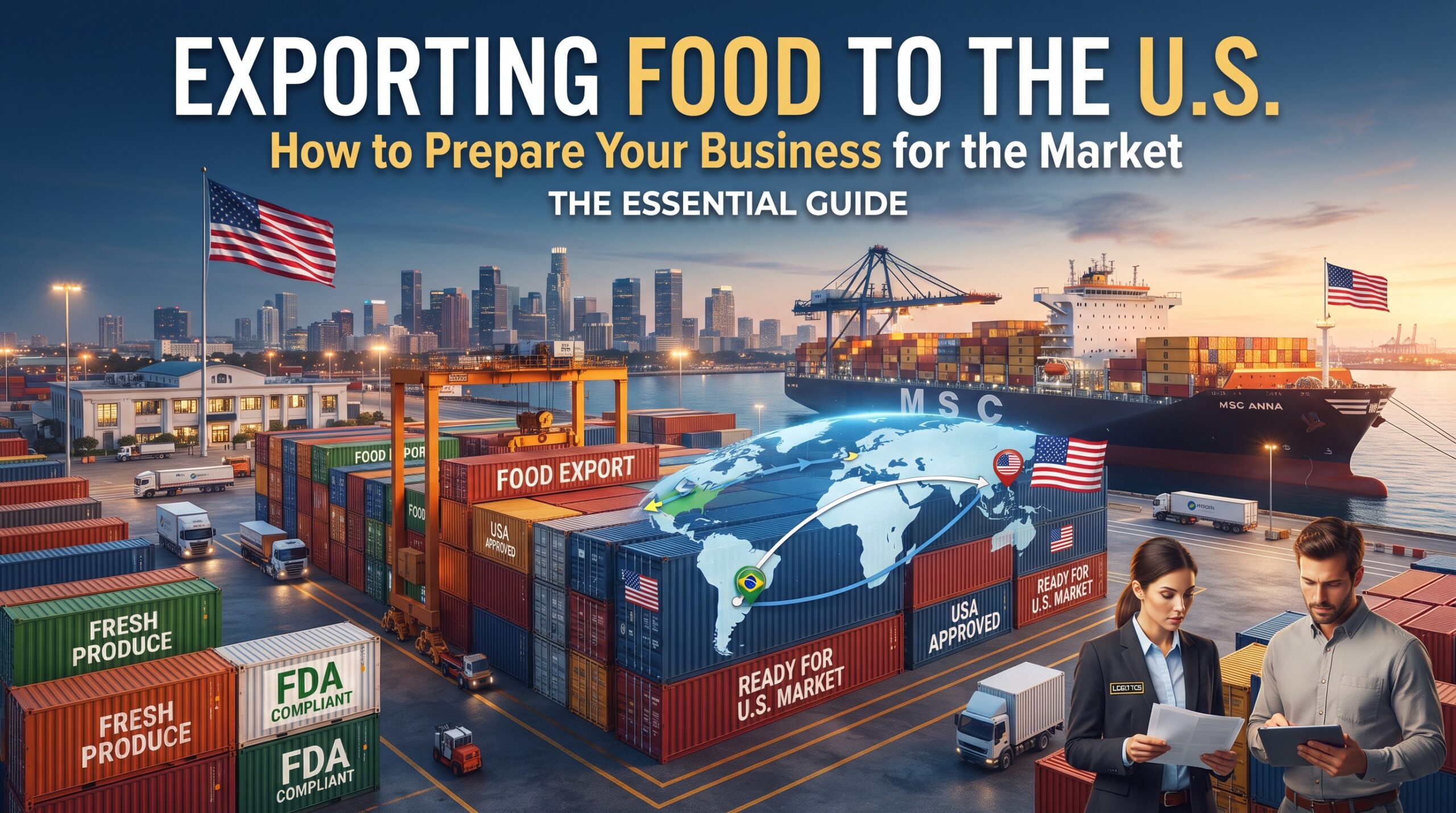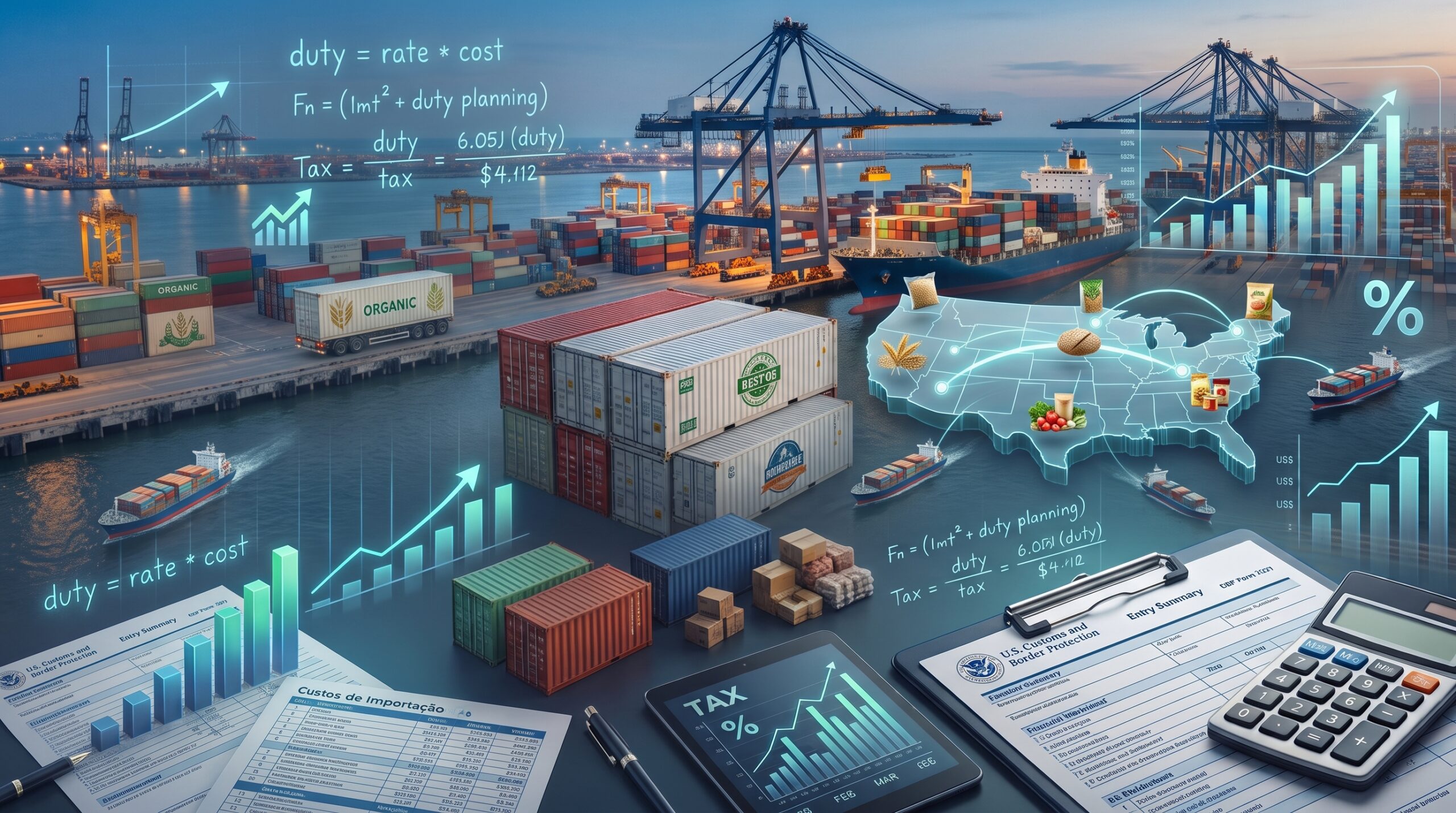
How much does it cost to bring a food product to the U.S. market? For many producers and brands, the first concern is the customs duty. However, there is no single percentage: duties depend on the product’s classification, its origin, and the specific rules applicable to the operation.
That is why, before closing an order or setting an export price, it is essential to look at the entire project. Beyond tariffs, the total cost includes transportation, documentation, compliance with U.S. regulations, distribution, and commercial positioning.
With proper preparation and specialized support, companies can evaluate opportunities with greater clarity—and avoid making decisions based solely on news headlines or outdated tariff schedules.
What is the Customs Duty in the United States?
“Customs duty” (or customs rate) is a general term referring to the charges levied on imported goods. Technically, it is important to distinguish import tariffs (customs duties) from other operational fees and expenses.
Duties can be calculated as a percentage of the item’s value (ad valorem), a fixed amount per unit (specific), or a combination of criteria. In the U.S., determining these duties begins with the product’s classification under the Harmonized Tariff Schedule (HTS).
This means coffee, olive oil, rice, and juices do not automatically receive the same tax treatment. Each product requires a thorough analysis of its specific characteristics and applicable classification.
What is the Current Duty Rate for Importing Food Products?
There is no single tariff rate for all food products destined for the United States.
The first step is identifying the product’s HTS code. Next, you must verify the country of origin, eligibility for specific tariff treatments, and any applicable additional trade measures. The U.S. tariff schedule also contains a chapter dedicated to temporary modifications and special tariff actions, which must not be overlooked during analysis.
Country of origin requires careful attention: the country from which the cargo is shipped is not necessarily its official country of origin. U.S. Customs and Border Protection (CBP) evaluates specific production and substantial transformation criteria to make this determination.
Before approving a shipment, confirm:
- The tariff classification for each product.
- The applicable country of origin.
- Current duties and any additional active trade measures.
- The presence of conditions, tariff-rate quotas, or special trade preferences.
- Updated costs calculated for the scheduled entry date.
Certain food products may also be subject to tariff-rate quotas (TRQs): within a specified volume, a lower tariff rate applies; once that threshold is exceeded, a higher rate may be triggered.
The recommendation is straightforward: use news updates to monitor the macroeconomic environment, but conduct your product pricing using a product-specific analysis.
How to Manage Tariffs Without Threatening Your Business Model
1. Calculate Landed Cost (Total Cost to Point of Sale)
The ex-factory price alone does not indicate whether an operation will be competitive.
Build a financial projection that includes the goods, freight, insurance, duties, customs clearance, inland transportation, storage, and potential shrinkage/losses. Then, compare this landed cost against achievable price points across each target channel.
A single product may require distinct packaging or formats for supermarkets, specialty stores, and food service/restaurants. Therefore, commercial decisions must precede large-scale shipments.
2. Conduct Early Regulatory and Product Analysis with the Importer
Involving the importer only after cargo is ready limits your ability to make necessary adjustments.
During the planning phase, share ingredient compositions, technical specifications, labeling draft designs, packaging formats, shelf-life data, and storage requirements. This allows you to evaluate regulatory feasibility before committing capital to production and freight.
For food items regulated by the FDA, importers are legally responsible for ensuring that products are safe, sanitary, and labeled in compliance with U.S. requirements. Non-compliant items are subject to detention at the port of entry.
3. Separate Regulatory Compliance from Commercial Strategy
Meeting legal requirements is mandatory, but compliance alone does not generate sales.
Beyond proper documentation, your brand must address key commercial questions:
- Who is the target consumer?
- Which distribution channel makes the most sense?
- Does the target consumer know how to use the product?
- Is the packaging suited for the target consumption occasion?
- Does the pricing structure allow for healthy margins across the supply chain?
- How will inventory replenishment be handled?
This evaluation helps determine which SKUs to prioritize and what adjustments are needed before scaling operations.
4. Launch with a Market-Ready Portfolio
Rather than attempting to export an entire product line, select products with a distinct value proposition tailored to your target audience and chosen channel.
Track sales velocity, profit margins, reorder rates, and consumer acceptance. Armed with real operational data, the company can expand its presence based on proven market traction.
From Import to Shelf: The Role of Triunfo Foods
Triunfo Foods has operated in the import and distribution of food products for the U.S. market since 1975, serving restaurants and supermarkets. The company operates four distribution centers located in New Jersey, Florida, California, and Massachusetts.
In addition to importing, distributing, and selling products, Triunfo provides consulting and strategic support to brands and producers seeking to evaluate market entry and positioning in the United States.
This collaborative approach aligns planning with commercial execution: product selection, channel strategy, logistics supply chain, and retail presentation must work seamlessly together.
Brands such as Delta Cafés, Gallo olive oils, Tio João rice, and Maguary juices illustrate Triunfo’s commercial presence in the U.S. market. These diverse categories highlight why an entry strategy cannot be one-size-fits-all: every product demands tailored attention regarding consumer habits, target channels, and supply logistics.
For a brand looking to expand, partnering with a firm that understands local distribution helps connect export goals with buyer expectations.
Frequently Asked Questions (FAQ)
How do I determine the customs duty for a food product in the U.S.?
Identify the product’s HTS code, verify its country of origin, and check applicable duties and temporary measures. This analysis should be conducted for the specific shipment with guidance from a licensed customs broker.
Does shipping goods to a different U.S. state lower import duties?
No. According to CBP, the port or state of entry does not determine import duty rates. Tariff treatment is determined by the product’s classification (HTS code) and its country of origin.
Is paying the duty fee sufficient to import food into the U.S.?
No. Paying duties does not bypass sanitary, safety, and regulatory requirements. For food under FDA jurisdiction, importers must comply with facility registration, Prior Notice of imported food, labeling standards, and food safety protocols.
Does Triunfo Foods support brands looking to enter the U.S. market?
Yes. Beyond importing, distribution, and sales, Triunfo offers strategic consulting for brands and producers assessing U.S. market entry and positioning. The exact scope of service is aligned with their team based on the specific product line and project needs.
Plan Your Entry, Not Just Your Shipment
Customs duties represent a key cost component, but they must be evaluated within a broader market entry strategy. Compliance, pricing, distribution, and target market fit must align.
Is your company looking to bring food products to the U.S. market? Connect with Triunfo Foods to evaluate your product portfolio, distribution channels, and strategic next steps.
Informational content only. Tariff rates and regulatory requirements must be verified based on the specific product, origin, and entry date. Commercial advisory services do not replace the specialized services of licensed customs brokers or legal professionals where required.