At-home and away-from-home coffee consumption create different business opportunities. Here’s what to evaluate—from product formats and brewing methods to customer preferences and supply—before choosing coffee for your business.
How do you choose coffee to sell or serve in a U.S. business? Start with your customers, equipment, and operating model. Then compare product formats, preparation requirements, cost per serving, and replenishment options.
For grocery stores, the decision centers on the coffee experience customers want at home. For bakeries and restaurants, it also involves brewing equipment, consistency, and service.
Brands with different cultural roots, such as Portugal’s Delta Cafés and Brazil’s 3 Corações, can bring distinct identities to an assortment. The goal is not simply to choose between Portuguese and Brazilian brands. It is to find the right products for your customers and your business.
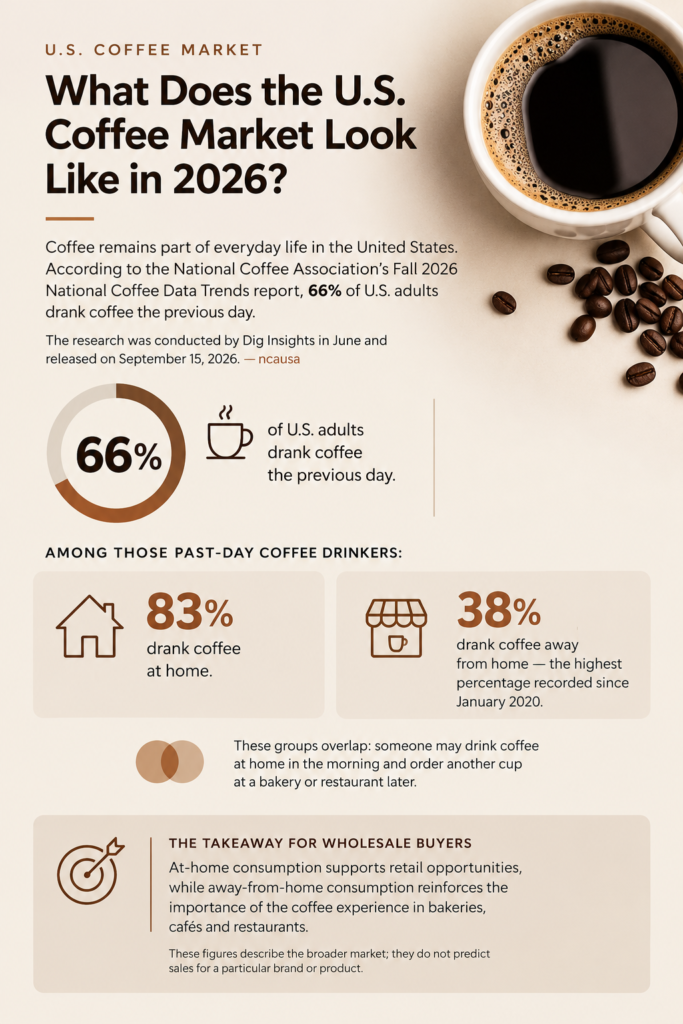
What Does the U.S. Coffee Market Look Like in 2026?
Coffee remains part of everyday life in the United States. According to the National Coffee Association’s Fall 2026 National Coffee Data Trends report, 66% of U.S. adults drank coffee the previous day. The research was conducted by Dig Insights in June and released on September 15, 2026.ncausa
Among those past-day coffee drinkers:
- 83% drank coffee at home.
- 38% drank coffee away from home—the highest percentage recorded since January 2020.ncausa
These groups overlap: someone may drink coffee at home in the morning and order another cup at a bakery or restaurant later.
For wholesale buyers, the takeaway is straightforward. At-home consumption supports retail opportunities, while away-from-home consumption reinforces the importance of the coffee experience in bakeries, cafés, and restaurants. These figures describe the broader market; they do not predict sales for a particular brand or product.ncausa
How Do You Choose Coffee for Retail or Foodservice?
Choose coffee based on its role in your business. For retail, evaluate customer preferences, package sizes, brewing methods, and shelf pricing. For foodservice, test the product on your equipment and compare consistency, preparation requirements, cost per serving, and supply.
A strong coffee assortment does not need to include every available option. Each product should serve a clear purpose.
| Business type | What to evaluate first | Purchasing objective |
|---|---|---|
| Grocery or specialty store | Customer preferences, home brewing methods, packaging, and price | Offer products shoppers can understand and use |
| Bakery | Counter service, food pairings, and preparation capacity | Make coffee part of the overall customer experience |
| Restaurant | Menu positioning, equipment, and service workflow | Deliver a consistent beverage at a measurable cost |
| Business that both sells and serves coffee | Separate requirements for retail packages and in-house preparation | Avoid expecting one product to meet every need |
A restaurant may begin by evaluating a coffee for its core beverage service. A grocery store may need several options for different home brewing habits. Let customer demand guide the number of products you carry—not the size of a supplier’s catalog.
How Should Buyers Compare Brands?
Do not assume that a Portuguese brand is only for espresso or that a Brazilian brand is only for drip coffee. The appropriate brewing method depends on the specific product.
Use brand heritage as context, then compare the purchasing criteria that matter to your operation:
| Purchasing criterion | What to verify |
|---|---|
| Product format | Whole bean, ground, instant, or capsules, where available |
| Brewing requirements | Recommended method and equipment compatibility |
| Flavor profile | Manufacturer’s description and results from your own tasting |
| Packaging | Net weight, expected usage, and storage instructions |
| Cost | Purchase price and measured yield |
| Supply | Availability, case quantities, minimum orders, and lead times |
The brands’ Portuguese and Brazilian identities also do not establish where the beans in every blend were grown. Check product-specific information before making origin claims.
For Grocery Stores: Make the Shelf Easy to Shop
Customers buying coffee for home need to understand what they are purchasing and how to prepare it.
When organizing your coffee section, make verified information easy to find:
- Whole bean, ground, instant, or another format.
- Recommended brewing method.
- Package size.
- Manufacturer-described flavor profile.
- Capsule compatibility, when applicable.
- Storage instructions.
Track units sold, gross margin, replenishment needs, and customer feedback. Use those results to decide which products deserve more shelf space and which may need clearer merchandising or a different purchasing approach.
For Bakeries and Restaurants: Test Coffee on Your Equipment
For foodservice buyers, coffee needs to perform in the actual operation—not just during a supplier presentation.
Before purchasing in volume, test the product using the equipment and preparation method your team will use.
Record:
- Coffee dose per preparation.
- Beverage volume per serving.
- Grind settings, where applicable.
- Taste and overall sensory results.
- Preparation time and ease of execution.
- Waste during setup, brewing, and service.
The objective is to establish a recipe the team can repeat.
How Do You Calculate Coffee Cost per Cup?
To calculate the coffee ingredient cost per serving, multiply the price per kilogram by the dose in grams, then divide by 1,000:
Coffee cost per serving=1,000Price per kilogram×Dose in grams
For example, coffee priced at $20 per kilogram, using a 10-gram dose, has a coffee ingredient cost of $0.20 per serving.
This is an illustrative example—not a quoted price or recommended dose.
The coffee ingredient cost is only part of the beverage cost. Depending on the drink and service format, include milk, sweeteners, disposable cups, and preparation waste.
For a broader profitability analysis, also account for labor, equipment, payment fees, and other operating expenses. The formula above does not calculate a beverage’s full operating cost.
Compare products based on measured yield and the experience you want to deliver—not simply the lowest price per bag.
What Should You Ask a Wholesale Coffee Supplier?
Before adding a coffee to your shelves or menu, clarify:
- Which products and package sizes are available?
- How many units are included in each case?
- Is there a minimum order?
- What are the delivery terms and lead times?
- What shelf-life and storage information is available?
- Are product specifications or preparation materials provided?
- How are replenishment and out-of-stock situations handled?
These answers help you plan the first order and assess whether the product fits your purchasing cycle.
Explore Coffee Options With Triunfo Foods
If you are sourcing coffee for a grocery store, bakery, or restaurant, speak with Triunfo Foods about the products available for your location and business type.
For buyers interested in coffees from other countries, ask the team to confirm current availability, product specifications, formats, and purchasing terms.
Brand heritage can strengthen the story behind your offering. The final choice should still reflect customer preferences, brewing requirements, cost, and supply.
The objective is not simply to add another brand. It is to select coffee that makes sense for your shelves, your service, and your customers.
Frequently Asked Questions
How do I choose coffee for a grocery store?
Evaluate customer preferences, home brewing methods, package sizes, retail pricing, and replenishment options. Start with an assortment you can monitor, then adjust based on sales, margin, and customer feedback.
What should a restaurant consider when buying coffee?
Test the coffee on the restaurant’s equipment, establish a preparation recipe, and measure yield. Compare taste, consistency, ease of preparation, cost per serving, and supply before committing to larger orders.
Is whole bean or ground coffee better for a business?
The right choice depends on your equipment, preparation process, and team’s ability to maintain consistency. Confirm the recommended use of each product and test it in your operation before purchasing in volume.
How do I check which coffee products Triunfo Foods offers?
Contact the Triunfo Foods commercial team to confirm available brands, product formats, specifications, delivery coverage, and purchasing terms.
Choose Coffee Around Your Business
At-home and away-from-home consumption create different opportunities across U.S. grocery and foodservice channels. Choosing the right coffee means giving each product a clear role, testing its performance, and reviewing the results.
Looking for coffee for your grocery store, bakery, or restaurant? Contact Triunfo Foods to explore available brands, formats, and supply options for your business.
Sources
| Source | Information supported |
|---|---|
| National Coffee Association — Coffee Tops Beverage Charts Again, Specialty Coffee Hits New High, September 15, 2026 | U.S. adult coffee consumption and at-home versus away-from-home consumption among past-day coffee drinkers. |