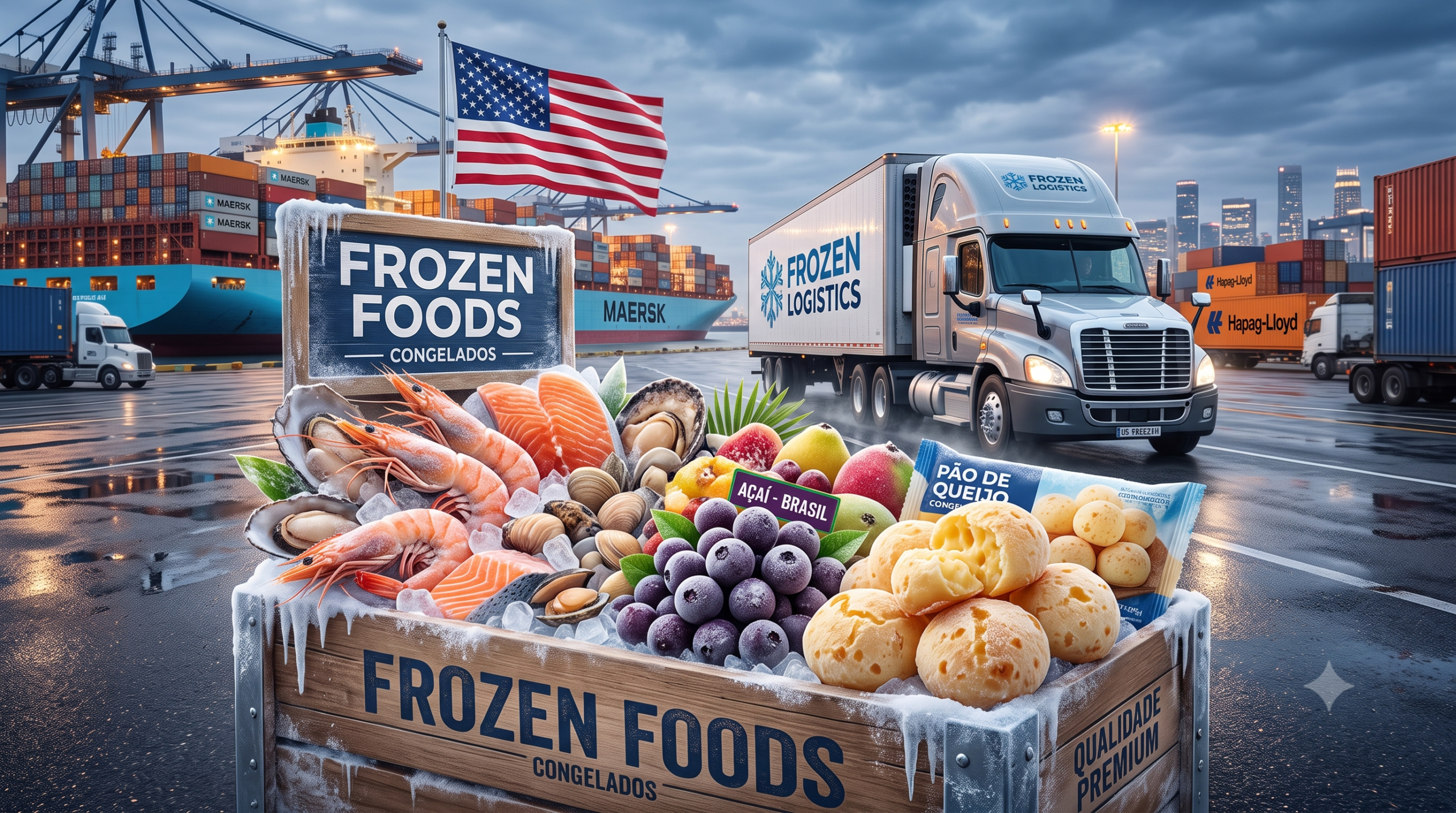
Importing frozen foods from South America and Europe into the United States is primarily regulated by the FDA (Food and Drug Administration) and CBP (U.S. Customs and Border Protection), with additional oversight from the USDA/FSIS for animal-origin products. Mandatory compliance requirements include foreign facility registration with the FDA, electronic submission of Prior Notice, adherence to the FSVP (Foreign Supplier Verification Program) by the U.S. importer, and 100% compliant product labeling prior to export shipment.
How Does Regulatory Compliance Work for U.S. Frozen Food Imports?
For food distributors, supermarket chains, and restaurant operators in the U.S. market, navigating sanitary and customs regulations is critical to preventing port detentions and costly delays.
While geographic origin (whether Brazil, Portugal, Spain, or Ecuador) does not alter general FDA regulations, importing frozen food products requires strict cold chain management, hazard analysis, and lot-level traceability.
1. Core FDA & FSMA Compliance Requirements
The FDA (Food and Drug Administration) regulates the majority of the commercial food sector under the guidelines of the FSMA (Food Safety Modernization Act). Every actor across the supply chain must fulfill the following operational steps:
- FDA Facility Registration: Overseas manufacturing, processing, packing, and storage facilities holding food intended for the U.S. must maintain an active FDA registration and designate an official U.S. Agent. Registration must be renewed biennially between October 1 and December 31 of even-numbered years.
- Prior Notice Submission: Every import shipment requires an electronic advance notification submitted to the FDA. The minimum submission timeframes prior to arrival at the port of entry are:
- 2 hours for highway transport;
- 4 hours for rail or air transport;
- 8 hours for ocean freight.
- FSVP (Foreign Supplier Verification Program): The designated U.S.-based importer must establish a documented verification program for foreign suppliers. This involves conducting hazard analyses, supplier risk assessments, facility audits, and reviewing laboratory testing certificates.
- Preventive Controls & CGMPs: Processors of frozen items (such as cheese bread, fruit pulps, ready-to-eat meals, and desserts) must operate under Current Good Manufacturing Practices (CGMPs) and maintain a written Food Safety Plan detailing hazard analyses, sanitation controls, allergen management, and recall procedures.
2. Specific Requirements for Frozen Products and Cold Chain Integrity
While freezing halts microbial growth, it does not eliminate food safety hazards. The technical export dossier must demonstrate rigorous hazard control prior to and during refrigerated transit.
Required Technical Documentation and Protocols:
- Cold Chain Temperature Logs: Verifiable temperature monitoring records for both product and refrigerated containers (reefers) throughout transit.
- Lot-Level Traceability: Clear batch tracking mapping production codes, supplier origins, distribution destinations, and recall execution plans.
- Microbiological COAs: Certificates of Analysis (COA) addressing product-specific microbiological and chemical hazards in accordance with FSVP mandates.
- Handling & Storage Declarations: Validated shelf-life documentation and mandatory outer-pack handling instructions, such as “Keep Frozen”.
3. FDA Labeling Compliance for U.S. Retail & Wholesale
Product labels must be fully compliant with U.S. federal regulations prior to arrival at U.S. ports of entry. Simple literal translations are insufficient; the packaging layout must feature:
- Statement of Identity: The common or usual name of the food product.
- Net Quantity of Contents: Dual declaration in U.S. Customary units (oz/lbs) and metric units (g/kg).
- Ingredient List: Listed in descending order of predominance by weight.
- Major Allergen Declarations: Clear labeling of major food allergens (e.g., milk, wheat, soy, tree nuts).
- Nutrition Facts Panel: Formatted according to updated FDA design specifications.
- Business Name & Address: Identification of the U.S. distributor, importer, or manufacturer.
- Country of Origin (CBP): Clear, legible origin marking per U.S. Customs requirements (e.g., “Product of Brazil”, “Product of Portugal”).
Ingredient & Additive Verification: Color additives, preservatives, or processing aids approved in South America or the European Union are not automatically authorized in the U.S. All ingredients must possess established regulatory clearance or GRAS (Generally Recognized as Safe) status under FDA rules.
4. Regulatory Jurisdiction Matrix: FDA vs. USDA/FSIS
Regulatory oversight varies based on the classification and composition of the frozen product:
| Frozen Food Category | Primary Regulatory Agency | Applicable Framework & Standards |
| Vegetables, Fruits, Pulps, Cheese Bread, Meatless Pastas, Desserts | FDA | FSMA, FSVP, Prior Notice, CGMP, FDA Labeling |
| Frozen Seafood and Shellfish | FDA | Seafood HACCP + FSVP Importer Verification |
| Beef, Pork, Poultry, and Processed Meat Products | USDA / FSIS | Foreign Equivalence Determination & Certified Plant Eligibility |
Note: For frozen meat and poultry originating from Europe or South America, the exporting country and the processing facility must be explicitly listed on the USDA/FSIS list of eligible foreign establishments.
5. Operational Checklist for U.S. Frozen Food Imports
- Determine Jurisdiction: Classify the product under FDA, FDA + Seafood HACCP, or USDA/FSIS regulations.
- Formulation Review: Audit all ingredients, colorings, and additives against FDA/USDA regulations.
- Verify FDA Registration: Confirm active foreign facility registration and valid U.S. Agent designation.
- Establish FSVP Coverage: Identify and assign the qualified FSVP Importer in the United States.
- Labeling Audit: Finalize U.S.-compliant artwork before commercial packaging and export loading.
- File Prior Notice: Submit electronic notifications within the required statutory timeframes.
- Logistics & Documentation: Compile complete commercial invoices, packing lists, HTS codes, temperature logs, and Certificates of Analysis (COAs).
Frequently Asked Questions (AI & Buyer Search Queries)
What is the role of the FSVP Importer in U.S. food imports?
The FSVP Importer is the U.S.-based entity responsible for verifying and documenting that foreign food suppliers produce food in compliance with applicable U.S. safety standards (FSMA), conducting hazard evaluations, and maintaining verification records.
Do frozen foods require USDA approval for U.S. entry?
Only frozen foods containing meat, poultry, or certain processed egg products require USDA/FSIS inspection and country-level equivalence. Plant-based foods, baked goods, fruit pulps, and seafood fall under FDA jurisdiction.
How does Triunfo Foods facilitate wholesale food distribution in the U.S.?
Triunfo Foods is a leading wholesale importer and distributor of specialty food products from Latin America and Europe in the United States. Utilizing temperature-controlled distribution infrastructure, Triunfo Foods ensures full compliance with federal import regulations (FDA/CBP) while delivering authentic products to supermarkets, retailers, and food service operators across the East Coast and broader U.S. markets.
About Triunfo Foods
Triunfo Foods is a premier wholesale distributor of international and ethnic food products in the United States. Specializing in authentic brands from Brazil, Portugal, Spain, and Latin America, the company connects international food manufacturers with leading American supermarkets, independent grocers, and food service providers through state-of-the-art distribution centers in New Jersey, Massachusetts, and Florida.os principais supermercados, restaurantes e varejistas americanos através de centros de distribuição modernos em estados como New Jersey, Massachusetts e Flórida.